Prompt Optimization: Master How to Get Better Results from AI Models
When you're working with prompt optimization, the process of refining input text to get more accurate, useful, and consistent responses from AI models. Also known as prompt engineering, it's not about writing fancy sentences—it's about giving the AI the right clues so it understands exactly what you need. Most people think AI just reads your words and guesses the answer. But the truth? A poorly written prompt can make even the smartest model give you nonsense. A well-tuned one turns it into a precise tool.
That’s why LLM prompts, the specific text inputs given to large language models to trigger desired outputs need structure. You don’t just say "Write me a blog post." You say "Write a 500-word blog post in casual tone for small business owners about AI tools that save time, using bullet points and real examples." That’s prompt optimization in action. It’s the difference between getting a vague answer and getting something you can use right away. And it’s not just for writers. Developers use it to get clean code snippets. Marketers use it to generate on-brand copy. Support teams use it to auto-answer customer questions without hallucinations.
Tools like generative AI, systems that create new text, images, or code based on input patterns don’t learn from your feedback the way a person does. They predict what comes next based on patterns in their training data. So if your prompt is fuzzy, the model fills in the gaps with likely—but wrong—guesses. That’s why techniques like role prompting ("Act as a senior developer...") or step-by-step instructions ("First, analyze the problem. Then, list three solutions.") work so well. They force the model to follow a clear path instead of wandering.
And it’s not just about getting better answers—it’s about saving money. Every extra token the AI generates costs you. A clear prompt cuts down on wasted output, reduces retry rates, and lowers cloud bills. Companies that optimize prompts see up to 40% lower LLM costs without changing models or hardware.
What you’ll find here aren’t theory-heavy guides. These are real, tested approaches from developers who’ve spent months tweaking prompts until they worked reliably in production. You’ll see how teams use style transfer prompts to match brand voice, how they build prompts that avoid hallucinations, and how they structure inputs so AI tools like ChatGPT or Claude behave like trained assistants—not guessers. Whether you’re building a chatbot, automating reports, or coding with AI, the quality of your output starts with your prompt.
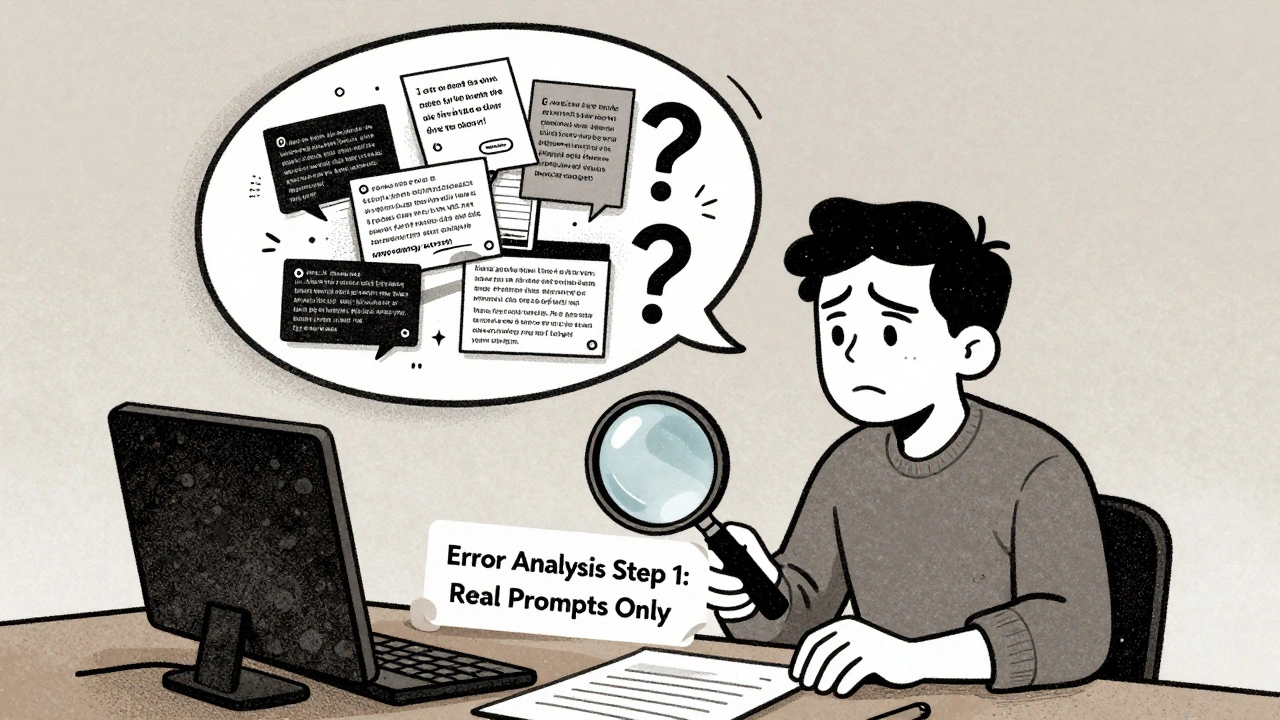
Error Analysis for Prompts in Generative AI: Diagnosing Failures and Fixes
Error analysis for prompts in generative AI helps diagnose why AI models give wrong answers-and how to fix them. Learn the five-step process, key metrics, and tools that cut hallucinations by up to 60%.
Read More