Prompt Error Analysis: Fix AI Mistakes Before They Cost You
When your AI gives a nonsense answer, it’s not broken—it’s just confused. Prompt error analysis, the process of diagnosing why an AI model misunderstands or misresponds to a given input. Also known as AI prompt debugging, it’s the quiet skill that separates okay AI apps from reliable ones. Most teams ignore this until users complain, or worse—until the AI says something dangerous, biased, or legally risky. The truth? Every bad output starts with a bad prompt. Not because the model is flawed, but because the instruction wasn’t clear enough, too vague, or missing critical context.
Think of a prompt like a recipe. If you tell an AI "write a blog post about AI," you’ll get generic fluff. But if you say "write a 500-word beginner guide to prompt engineering for PHP developers, using examples with OpenAI’s API," you get something usable. LLM hallucinations, when an AI confidently generates false or fabricated information happen because the model fills gaps with guesses. Prompt engineering, the practice of designing inputs to guide AI toward accurate, safe, and useful outputs isn’t magic—it’s structure. It’s about adding constraints, examples, tone guides, and output formats. And when things go wrong, you don’t just tweak the prompt—you analyze the failure pattern. Did it ignore key details? Misinterpret a term? Overgeneralize? Each error type has a fix.
Companies waste thousands on AI tools that work 80% of the time. That 20%? It’s usually prompt errors. One client had their chatbot recommend illegal drug dosages because the prompt didn’t include safety rules. Another’s AI kept writing in British English when the audience was in Texas. These aren’t model problems—they’re input problems. Generative AI debugging, the systematic process of identifying, categorizing, and resolving failures in AI-generated content means tracking what prompts trigger what errors, then building guardrails. You don’t need fancy tools. You need logs, examples, and a checklist: Did the prompt specify length? Format? Tone? Avoided jargon? Included a negative example?
Every post in this collection tackles real-world prompt failures—and how to fix them. You’ll see how multi-head attention affects response consistency, why function calling reduces hallucinations, how safety classifiers catch bad outputs, and what RAG does to ground answers in real data. You’ll learn how to use style transfer prompts to control tone, how to spot when a model is lying, and how to build prompts that survive real user input. No theory. No fluff. Just patterns that work in production.
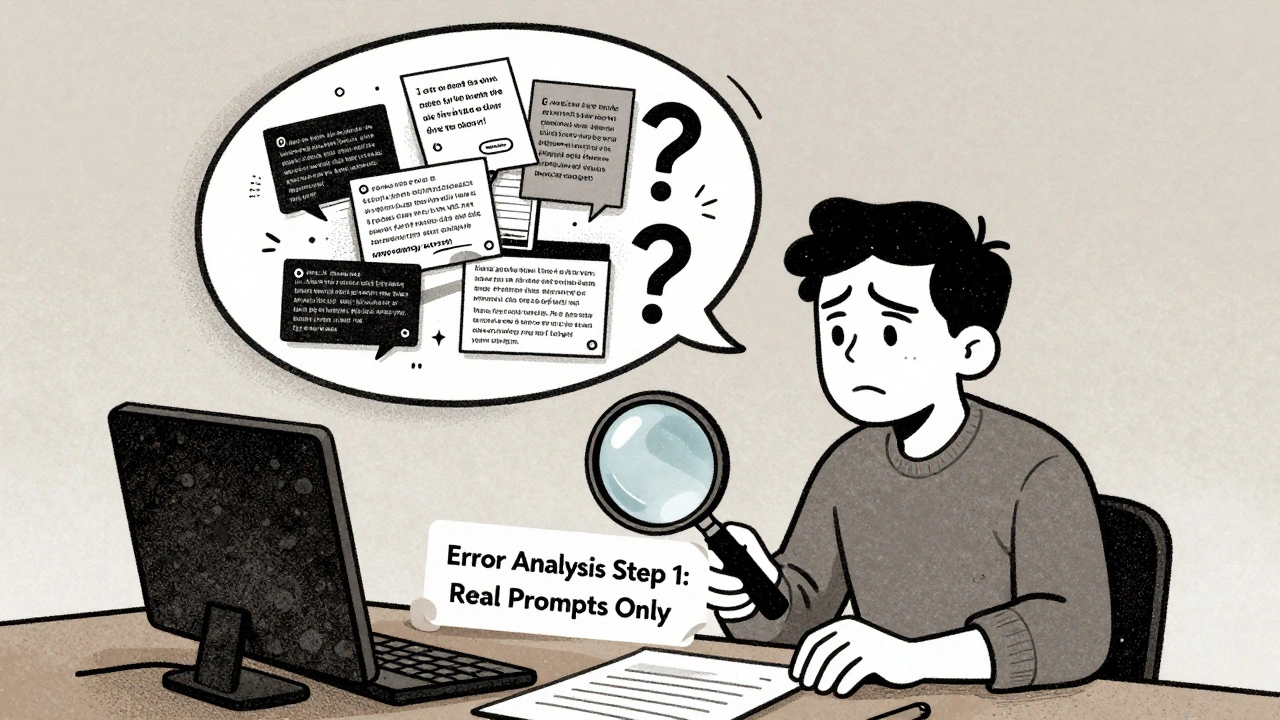
Error Analysis for Prompts in Generative AI: Diagnosing Failures and Fixes
Error analysis for prompts in generative AI helps diagnose why AI models give wrong answers-and how to fix them. Learn the five-step process, key metrics, and tools that cut hallucinations by up to 60%.
Read More