LLM Interoperability: Connect AI Models Across Systems and Tools
When you work with LLM interoperability, the ability to make different large language models work together seamlessly across platforms, tools, and data sources. Also known as model agnosticism, it means your AI app isn’t stuck with one model or one cloud provider. You can switch between OpenAI, Claude, or an open-source model on demand—without rewriting your whole system. This isn’t just about convenience. It’s about control, cost, and safety. If one model starts hallucinating too much, you swap it out. If another is cheaper for low-volume tasks, you route traffic there. If your compliance team needs to audit training data, you pick a model that lets you track it.
Real LLM interoperability relies on three key pieces: function calling, a standardized way for LLMs to trigger external tools like databases, APIs, or custom scripts. Also known as tool use, it lets your model act, not just talk. Then there’s RAG, retrieval-augmented generation, which lets any LLM pull in your private data without retraining. Also known as context injection, it turns a generic model into a domain expert on the fly. And finally, model switching, the practice of routing requests to different models based on cost, speed, or accuracy needs. Also known as dynamic model selection, it’s how smart teams cut cloud bills by 40% without losing quality. These aren’t separate features—they’re the gears that make interoperability work. Without function calling, your model can’t access live data. Without RAG, it can’t use your company’s documents. Without model switching, you’re locked into expensive or unreliable options.
Most teams think interoperability means swapping APIs. It doesn’t. It means building systems that don’t care which model is running underneath. That’s why you see companies using the same code to talk to GPT-4, Llama 3, or Mistral—because they built their logic around standards, not vendors. You’ll find posts here that show exactly how to do this: how to design prompts that work across models, how to monitor performance when switching, how to secure data flow between tools, and how to avoid vendor lock-in without losing reliability. You’ll see real benchmarks, cost comparisons, and error fixes from teams running this in production. No theory. No fluff. Just what works when your AI app has to be fast, cheap, and safe.
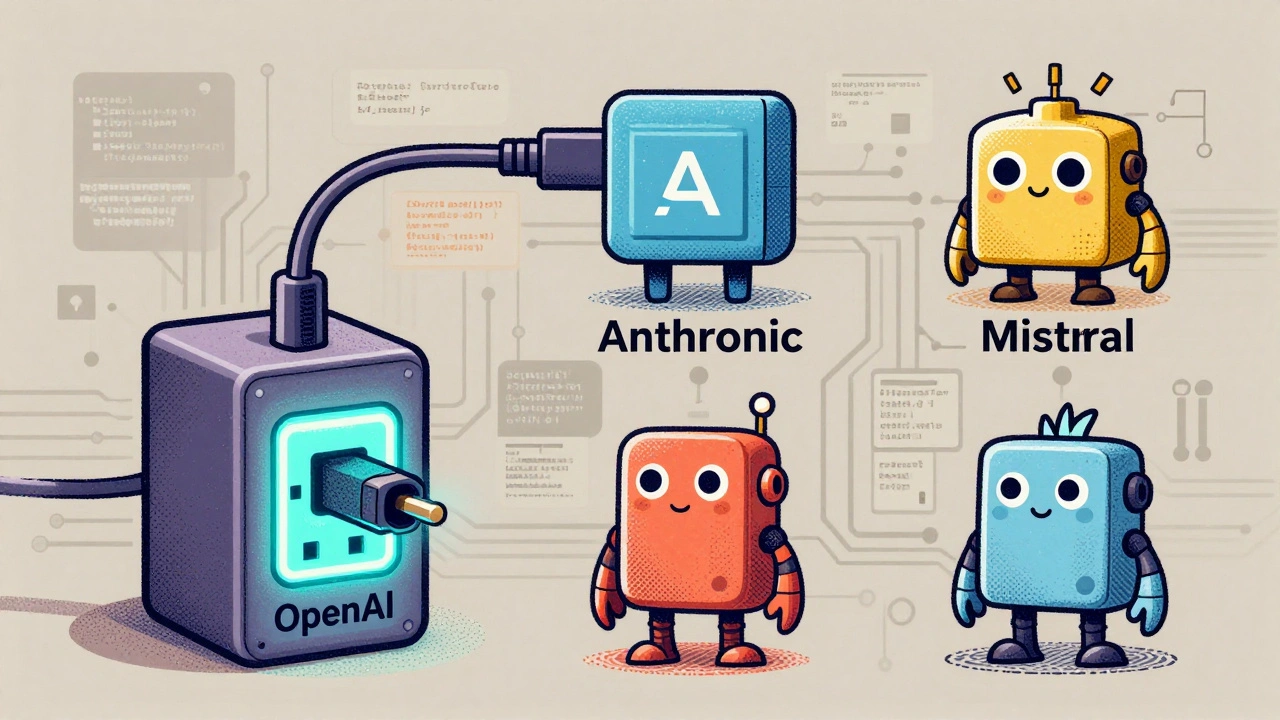
Interoperability Patterns to Abstract Large Language Model Providers
Learn how to abstract large language model providers using proven interoperability patterns like LiteLLM and LangChain to avoid vendor lock-in, reduce costs, and maintain reliability across model changes.
Read More