LiteLLM: Fast, Affordable LLM Proxy for Production AI Apps
When you’re building AI apps in PHP, LiteLLM, a lightweight proxy that standardizes access to large language models like OpenAI, Anthropic, and local models. Also known as an LLM routing layer, it lets you switch between models without changing your code—critical when one API goes down or gets too expensive. Most developers start with OpenAI’s API, but then hit walls: pricing spikes, rate limits, or sudden model deprecations. LiteLLM solves that by acting like a universal adapter. You write your app once, then point it to LiteLLM. Behind the scenes, it routes requests to whichever model you pick—GPT-4, Claude 3, Llama 3, even self-hosted ones—all through the same interface.
LiteLLM isn’t just about switching models. It’s about control. You can set up fallbacks: if OpenAI’s API responds slowly, LiteLLM automatically tries Anthropic. It tracks usage per model so you know where your money goes. It even lets you inject custom headers, apply prompt templating, and log every call for debugging. For teams running AI in production, this isn’t a luxury—it’s a necessity. Companies using LiteLLM report up to 40% lower costs by shifting traffic to cheaper models during off-peak hours. It also cuts deployment time. Instead of rewriting your entire chatbot logic when you migrate from GPT-3.5 to GPT-4, you just update one config file.
And it works with PHP. You don’t need Python or Node.js. You can call LiteLLM via HTTP from any PHP app using cURL or Guzzle. It integrates cleanly with Composer, so you can manage it like any other dependency. If you’re using vector databases for RAG, or need to throttle calls to avoid hitting API limits, LiteLLM handles that too. It’s the glue between your PHP backend and the messy world of AI APIs.
Below, you’ll find real-world guides on how to use LiteLLM in production—how to set up autoscaling, reduce latency, monitor costs, and avoid common pitfalls when mixing multiple LLM providers. Whether you’re optimizing a customer support bot or building a multi-model analytics tool, these posts give you the exact code patterns and configs that work.
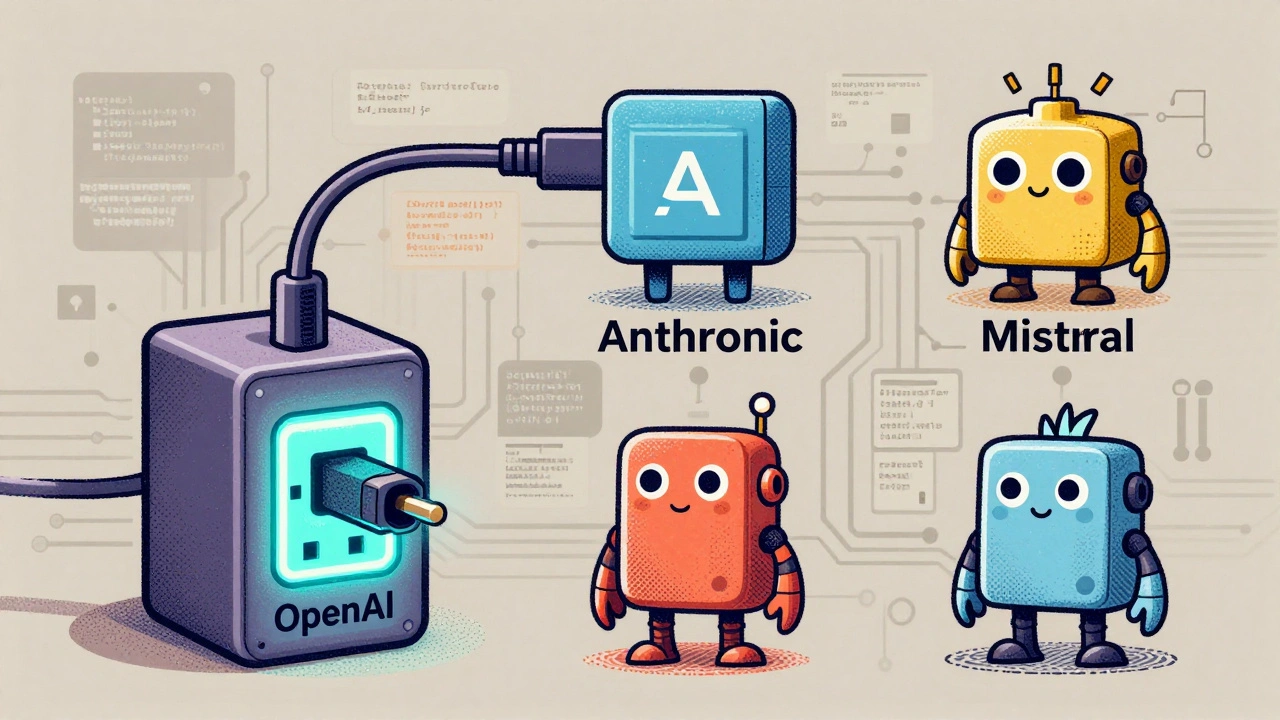
Interoperability Patterns to Abstract Large Language Model Providers
Learn how to abstract large language model providers using proven interoperability patterns like LiteLLM and LangChain to avoid vendor lock-in, reduce costs, and maintain reliability across model changes.
Read More