Diffusion Models: How AI Creates Images from Text and What You Need to Know
When you type Diffusion Models, a class of generative AI systems that build images step-by-step by reversing noise. Also known as denoising diffusion models, they’re the engine behind tools like Stable Diffusion and DALL·E 3—turning simple text into detailed photos, art, and designs in seconds. Unlike older AI that guessed pixels all at once, diffusion models start with pure randomness and slowly clean it up, like polishing a foggy mirror until a clear picture appears. This slow, deliberate process is why they get details right—hair strands, lighting, reflections—that earlier models missed.
They work because they learn from millions of image-text pairs. Each time you ask for "a red fox in a snowstorm," the model recalls patterns from training: how fur looks under winter light, how snowflakes scatter, how shadows fall. This isn’t magic—it’s math. The model uses a neural network to predict what noise to remove at each step, guided by your words. And it’s not just for pretty pictures. Stable Diffusion, an open-source diffusion model widely used by developers and designers runs on consumer GPUs, letting you build custom image tools without paying for cloud APIs. Meanwhile, text-to-image AI, the application layer built on diffusion models is now in design apps, e-commerce product generators, and even medical visualization tools.
But diffusion models aren’t perfect. They still struggle with hands, text in images, and consistent character faces. That’s why companies use them with guardrails—like content moderation systems and human review loops. You’ll find posts here that dig into how to use them safely, how to reduce costs when running them at scale, and how to connect them to PHP backends for custom apps. Some posts show how to combine them with retrieval systems so your AI pulls from your own image library. Others break down how to fine-tune them for brand-specific styles without retraining from scratch.
What you’re holding here isn’t theory. It’s what developers are actually using in 2025. Whether you’re building a photo editing plugin, automating product catalogs, or just experimenting with AI art, these posts give you the real-world code, trade-offs, and fixes—not just the marketing spin. You’ll learn what works, what breaks, and how to make diffusion models do what you need—without blowing your budget or your timeline.
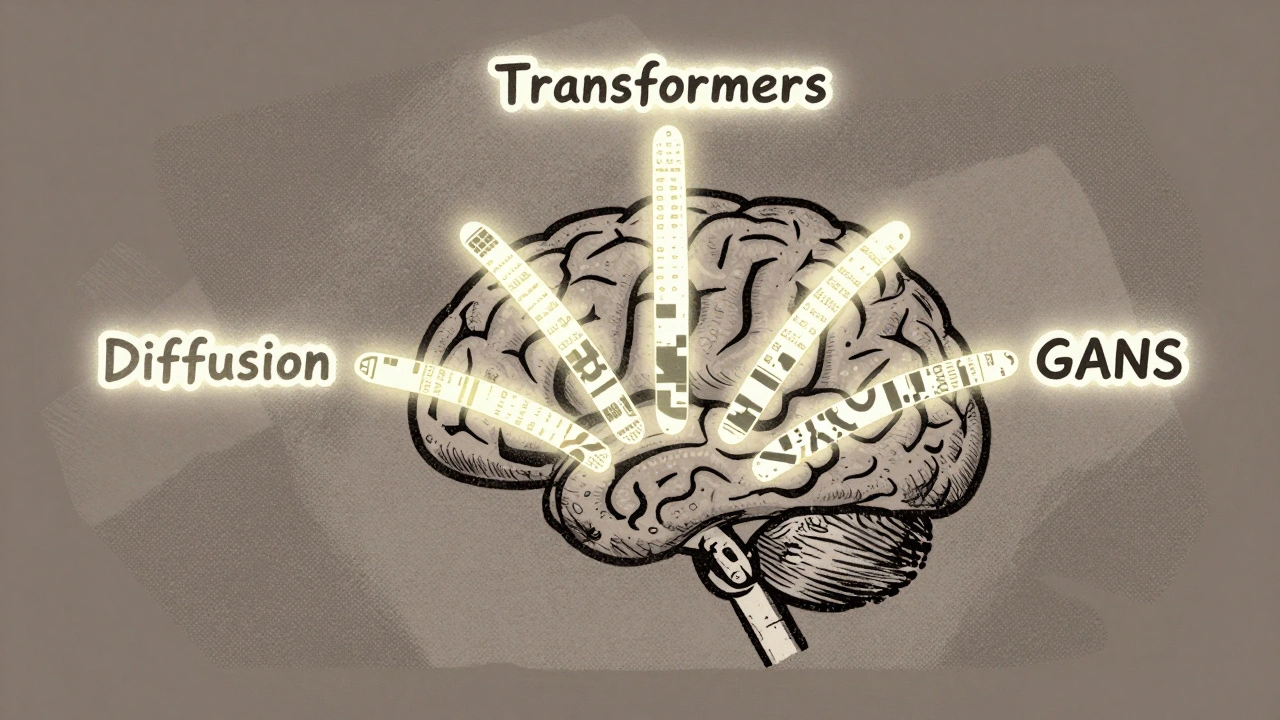
Foundational Technologies Behind Generative AI: Transformers, Diffusion Models, and GANs Explained
Transformers, Diffusion Models, and GANs are the three core technologies behind today's generative AI. Learn how each works, where they excel, and which one to use for text, images, or real-time video.
Read More