AI Production: Real-World Deployment, Costs, and Governance for Large Language Models
When you're building AI production, the process of moving large language models from experiments into live, business-critical systems. Also known as LLM deployment, it's where theory meets traffic, budgets, compliance, and users who expect answers right now. Most teams think AI production means training a better model. It doesn't. It means keeping a model alive, accurate, cheap, and legal while thousands of people use it every minute.
Real AI production involves enterprise data governance, policies and tools that track how training data is used, who can access outputs, and how to avoid legal risks. It means using generative AI cost optimization, strategies like autoscaling, spot instances, and scheduling to slash cloud bills without losing speed. And it means understanding how large language models, AI systems that generate human-like text by predicting the next word based on massive datasets behave under load—not just when they’re fresh out of the lab.
You can’t ignore LLM deployment just because your model works in a notebook. If your chatbot gives wrong answers during peak hours, if your content filters miss harmful output, if your bill spikes because no one set up autoscaling—you’re not doing AI production. You’re doing trial and error with a credit card. The posts below cover how companies actually do this right: how they measure governance with KPIs like MTTR and policy adherence, how they lock down model weights and dependencies to prevent supply chain attacks, how they use RAG to keep answers grounded in real data, and how they cut cloud costs by 60% without sacrificing performance.
Some of these systems run on thousands of GPUs. Others run on a single server with smart caching. Either way, they all face the same problems: who pays, who’s liable, and how do you keep it running when the lights are on? This isn’t about fancy research. It’s about shipping something that works, stays secure, and doesn’t bankrupt your team. What follows isn’t theory. It’s what developers, engineers, and compliance officers are doing today to make AI production actually work.
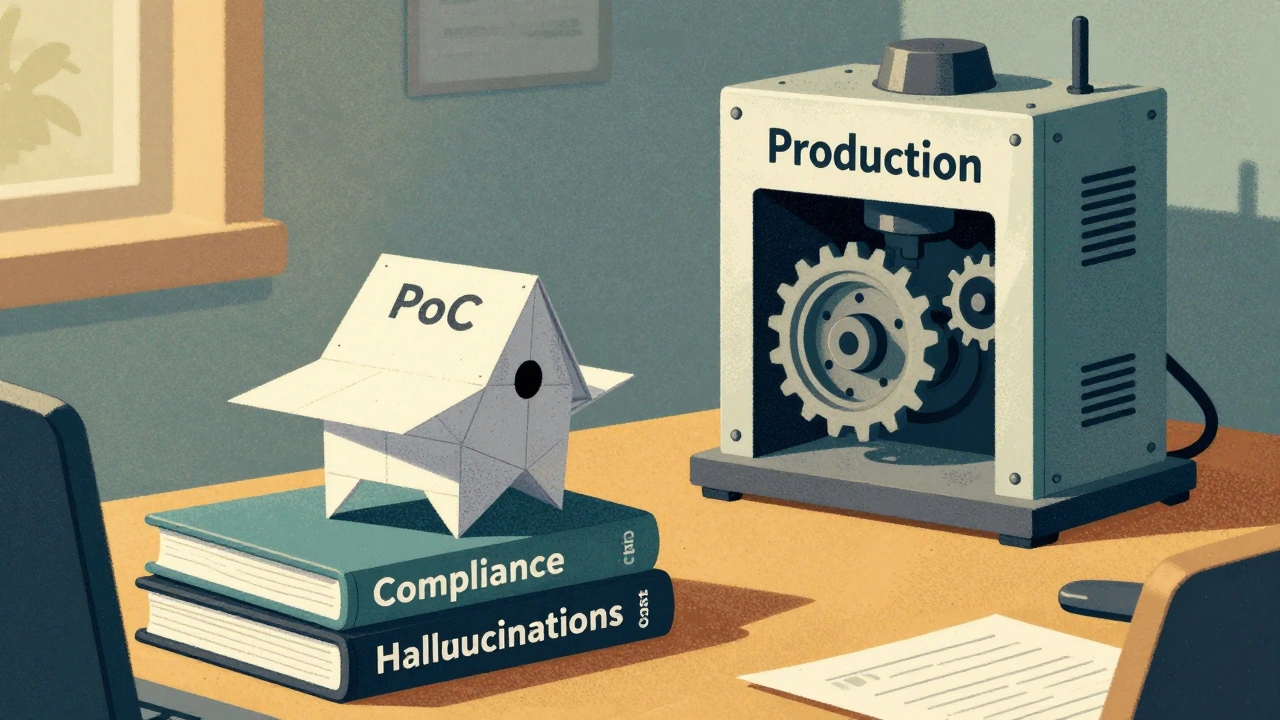
From Proof of Concept to Production: Scaling Generative AI Without Surprises
Only 14% of generative AI proof of concepts make it to production. Learn how to bridge the gap with real-world strategies for security, monitoring, cost control, and cross-functional collaboration - without surprises.
Read More