AI Architecture: How Modern Systems Power LLMs, Tools, and Scalable AI
When you think of AI architecture, the underlying structure that defines how artificial intelligence systems are built, connected, and scaled. Also known as AI system design, it’s not just about code—it’s about how models, data, security, and infrastructure work together to make AI reliable, fast, and affordable. Most people see AI as a black box that answers questions, but behind every smart response is a carefully designed architecture. Think of it like a car: the engine (the model) matters, but so does the transmission (how inputs flow), the fuel system (data pipelines), and the safety controls (governance and moderation).
Modern large language models, AI systems trained on massive text datasets to understand and generate human-like language. Also known as LLMs, they rely on core components like multi-head attention, a mechanism that lets models process different parts of text simultaneously to capture context, tone, and meaning and retrieval-augmented generation, a method that lets LLMs pull in real-time, custom data instead of guessing from memory. These aren’t just buzzwords—they’re the reason your chatbot doesn’t hallucinate every third answer. But even the best model fails without the right architecture around it. That’s why companies use distributed training, the process of splitting AI model training across thousands of GPUs to handle massive datasets and multi-tenancy, a design that lets one AI system serve multiple customers securely without mixing their data. Without these, scaling AI means crashing servers, leaking data, or going broke on cloud bills.
AI architecture today isn’t just about making models smarter—it’s about making them safe, cheap, and sustainable. You need autoscaling, automatic adjustments to GPU resources based on real-time demand to avoid paying for idle power. You need confidential computing, hardware-level encryption that protects data even while the AI is processing it to meet enterprise compliance rules. And you need tool use, the ability for LLMs to call external APIs and databases to get accurate, live information so your AI doesn’t make things up. These aren’t optional upgrades—they’re the baseline for any production system.
What you’ll find below isn’t a list of random articles. It’s a map of the real-world AI architecture decisions developers and teams are making right now. From how to cut cloud costs by 60% with spot instances, to how to stop AI from leaking customer data in multi-tenant apps, these posts show you what works—not what sounds good on a slide.
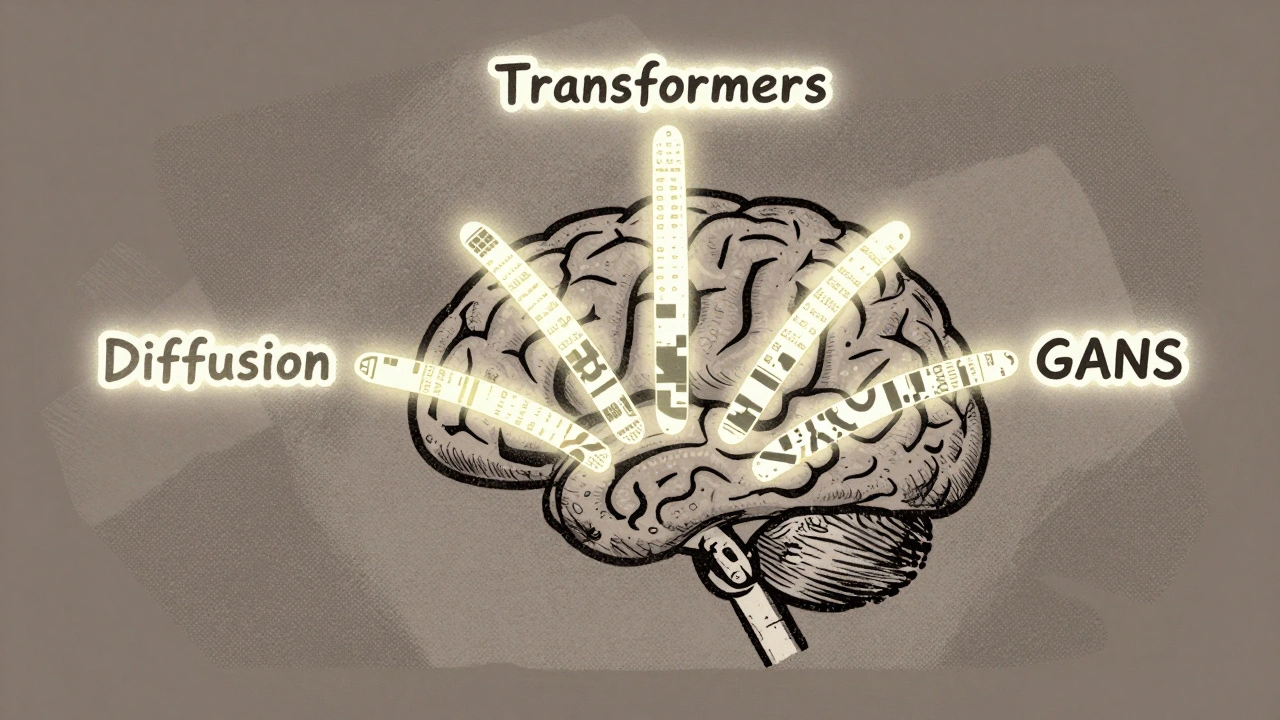
Foundational Technologies Behind Generative AI: Transformers, Diffusion Models, and GANs Explained
Transformers, Diffusion Models, and GANs are the three core technologies behind today's generative AI. Learn how each works, where they excel, and which one to use for text, images, or real-time video.
Read More