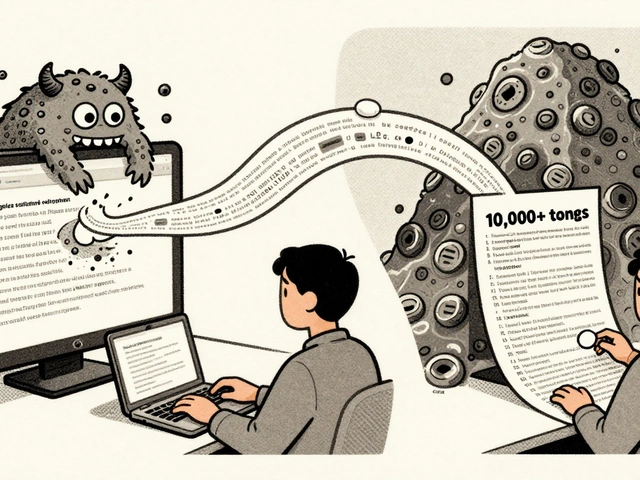
You want to run a large language model on your phone or laptop. It sounds like the future of privacy and speed, but right now, it feels impossible. Flagship models like Llama v3-70B is a massive AI model with 70 billion parameters that requires immense cloud resources need data centers, not pocket-sized batteries. Even smaller, efficient models like Phi-3 is a compact language model designed for efficiency but still demanding for many consumer devices often choke on the limited RAM of standard hardware. The gap between powerful AI and everyday devices is wide. But it’s closing fast.
The bridge across this gap is built with two main tools: compression and quantization. These techniques shrink models without destroying their brains. They turn heavy, floating-point math into lean, integer-based operations. This allows you to deploy sophisticated AI locally. You get instant responses. Your data never leaves your device. Let’s look at how these methods work and which ones actually deliver results in 2026.
Why Size Matters for Edge AI
Edge computing means processing data where it is created. For an LLM, this means running inference on your CPU, GPU, or NPU instead of sending prompts to a remote server. The benefits are obvious. Latency drops to near zero because there is no network travel time. Privacy improves because your sensitive documents stay on your machine. Reliability increases because you don’t need an internet connection.
But hardware has limits. A smartphone might have 12GB of RAM. A laptop might have 16GB. An embedded sensor might have less than 1GB. Compare that to a cloud GPU cluster with terabytes of memory. To fit a model into these tight spaces, we must reduce its footprint. We do this by reducing the precision of the numbers the model uses. Standard models use 16-bit or 32-bit floating-point numbers (FP16 or FP32). These are precise but bulky. Quantization swaps them for 8-bit, 4-bit, or even 3-bit integers. This can cut model size by half, quarter, or more.
| Precision Type | Bits per Parameter | Relative Model Size | Typical Use Case |
|---|---|---|---|
| FP32 | 32 | 100% | Cloud training servers |
| FP16 / BF16 | 16 | 50% | Standard inference GPUs |
| INT8 | 8 | 25% | High-end laptops, some phones |
| INT4 | 4 | 12.5% | Most modern smartphones |
| INT3 | 3 | ~9.4% | Extreme edge constraints |
Post-Training vs. Quantization-Aware Training
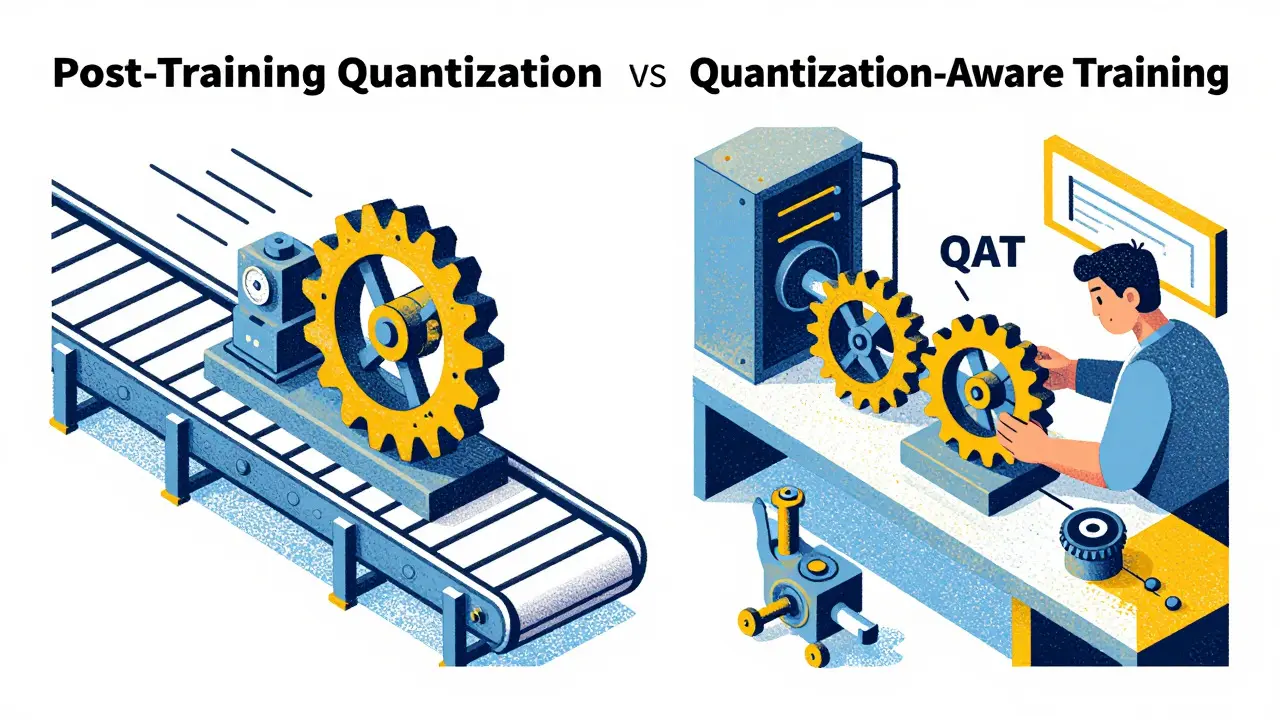
There are two ways to apply quantization. You can do it after the model is trained, or you can bake it into the training process. Each has trade-offs.
Post-Training Quantization (PTQ) is the quick path. You take a pre-trained model and convert its weights to lower precision. It’s fast. It doesn’t require access to the original training dataset. You just need a small calibration set of data to help the converter understand the range of values. PTQ is popular because it’s easy. Developers can grab a model from Hugging Face, run a script, and deploy. However, accuracy usually drops. The model forgets some nuances because the low-precision format forces it to round off important details.
Quantization-Aware Training (QAT) is the slow, careful path. During training, the model simulates low-precision arithmetic. It learns to adjust its weights so they survive the rounding process. QAT preserves accuracy much better than PTQ. But it requires retraining or fine-tuning the model. This takes compute power and time. If you don’t own the model, QAT is hard to implement. Most open-source users stick to PTQ unless they have the resources for QAT.
Advanced Techniques: Vector Quantization and TOGGLE
Traditional quantization treats each weight independently. It looks at one number, rounds it, and moves to the next. This ignores relationships between weights. Newer methods fix this blind spot.
GPTVQ is a vector quantization method developed by Qualcomm that groups parameters together to preserve joint distributions changes the game. Instead of individual rounding, GPTVQ quantizes groups of parameters. It considers how weights interact. This approach maintains accuracy far better than standard methods. Experiments show GPTVQ achieves near-original accuracy while drastically shrinking model size. This makes it ideal for deploying powerful models on edge chips.
Another breakthrough is TOGGLE is Temporal Logic-Guided Large Language Model Compression, a framework using formal methods to enforce linguistic properties during compression. Published in late 2025, TOGGLE integrates Signal Temporal Logic (STL) into the compression pipeline. It formally specifies what linguistic rules the compressed model must follow. It uses Bayesian optimization to find the best layer-wise quantization settings. The result? Up to 68.8% reduction in model size and 3.3x fewer computational operations (FLOPs), all while keeping the language quality intact. Crucially, TOGGLE works without retraining. This is huge for developers who need verified, reliable compression.
Unified Frameworks: UniQL and On-Device Adaptation
Compression isn’t just about static file size. It’s about dynamic performance. Models behave differently depending on the hardware load. UniQL is a unified framework combining post-training quantization and low-rank compression for configurable on-device deployment addresses this. UniQL allows models to adapt on the fly. It performs adaptive pruning based on system utilization. If your battery is low, UniQL can aggressively prune the model to save energy. If you need speed, it adjusts latency settings. This flexibility is key for real-world edge applications where conditions change constantly.
Tools for Developers: AIMET and Qualcomm AI Hub
You don’t need to build these algorithms from scratch. The industry provides robust toolkits. Qualcomm AI Model Efficiency Toolkit (AIMET) is an open-source library providing advanced quantization and compression techniques for neural networks is the gold standard for many developers. AIMET supports both PTQ and QAT. It offers visualizations to help you debug accuracy loss. It integrates with PyTorch and TensorFlow. Using AIMET, you can compress models with just a few lines of code.
Alongside AIMET, the Qualcomm AI Hub is a portal offering over 100 pre-optimized AI models ready for edge deployment provides ready-to-use models. You can browse, test, and download models that are already quantized for specific Snapdragon processors. Some achieve up to 4x faster inference compared to unoptimized versions. This saves weeks of engineering time.

Practical Steps to Deploy a Compressed LLM
If you want to try this today, here is a realistic workflow. Start with a base model like Llama 3 8B. Don’t start with the largest model; start small. Then follow these steps:
- Choose your target precision. INT4 is the sweet spot for most modern smartphones. It fits in memory and runs reasonably fast. Try INT8 first if you fear accuracy loss.
- Select a calibration dataset. For PTQ, you need a small set of text representative of your use case. 100-500 samples are often enough. This helps the quantizer determine the scale factors.
- Run the quantization. Use AIMET or a similar library. Apply symmetric or asymmetric quantization depending on your model’s weight distribution. Symmetric is simpler and faster.
- Evaluate accuracy. Test the compressed model against a benchmark like MMLU or your own internal metrics. Compare it to the FP16 baseline. If accuracy drops below your threshold, try mixed-precision quantization. Keep critical layers (like embedding heads) in higher precision.
- Optimize for hardware. Use runtime libraries like ExecuTorch or ONNX Runtime to execute the model. Ensure you’re leveraging the NPU if available. Software emulation of quantized ops on CPU is slower than native hardware support.
Layer-Specific Optimization
Not all parts of a model are equal. Embedding layers and output head layers often account for a large fraction of the total size in smaller models. Compressing these layers aggressively can hurt performance disproportionately. Research shows that applying stronger quantization to middle transformer layers while preserving higher precision in input/output layers yields better results. This targeted approach maximizes compression ratio without sacrificing the model’s ability to understand context or generate coherent text.
What is the difference between INT4 and INT8 quantization?
INT4 uses 4 bits per weight, halving the memory usage of INT8. This allows larger models to fit on smaller devices. However, INT4 causes more information loss, potentially reducing accuracy. INT8 is safer for accuracy-critical tasks, while INT4 is better for extreme space constraints.
Do I need to retrain my model for quantization?
No, not necessarily. Post-Training Quantization (PTQ) allows you to compress a model without retraining. It only requires a small calibration dataset. Retraining (QAT) is optional and used when PTQ causes unacceptable accuracy drops.
Can I run Llama 3 70B on a smartphone?
Currently, no. Even with aggressive 3-bit quantization, the 70B parameter count exceeds the RAM of most consumer phones. Models like Llama 3 8B or Phi-3 are realistic targets for high-end mobile devices.
What is GPTVQ and why is it important?
GPTVQ is a vector quantization technique that groups parameters together rather than treating them individually. This preserves the relationships between weights, leading to higher accuracy after compression compared to traditional methods.
How does TOGGLE improve compression?
TOGGLE uses formal logic to enforce linguistic rules during compression. It ensures the compressed model still follows grammar and syntax norms, achieving significant size reductions without manual tuning or retraining.
Which tools should I use for quantizing models?
Qualcomm AIMET is a top choice for advanced quantization. For easier deployment, check the Qualcomm AI Hub for pre-optimized models. Open-source alternatives include bitsandbytes and GGUF implementations for llama.cpp.