You’ve built a brilliant chatbot. It’s witty, it knows your product inside out, and on day one, it feels like talking to a real person. Then, three days later, the user comes back for a follow-up question. Suddenly, the bot has forgotten its name, switched from casual banter to stiff corporate speak, or worse-contradicted something it said ten minutes ago. This isn’t just annoying; it breaks trust. In the world of Generative AI, this phenomenon is known as persona drift. And fixing it requires more than just a good prompt-it demands rigorous Persona Calibration.
If you’re building AI agents that need to feel human-or at least consistently artificial-you’re fighting a battle against entropy. Large Language Models (LLMs) are probabilistic engines. They don’t "remember" who they are in the way humans do; they predict the next token based on context windows that eventually fill up and reset. Without explicit calibration, your carefully crafted persona dissolves into generic assistant-speak within a few exchanges. Here’s how to stop the drift and keep your AI consistent across sessions and channels.
Why Your AI Persona Drifts (And Why It Matters)
Let’s be honest: most developers treat personas as static text blobs pasted into a system prompt. You write, "You are an empathetic support agent named Alex," and call it a day. But research shows this approach fails hard over time. According to benchmarks from Sun et al. (2024), current systems achieve decent consistency (68-82%) within a single session. But drop that same agent into a new conversation 48 hours later without reinforcement, and consistency plummets to 42-57%. That’s a coin flip.
The problem stems from how LLMs handle context. As conversations lengthen, older instructions get pushed out of the active context window. The model starts relying more on recent tokens and less on the original system prompt. Add in channel switching-moving from text chat to voice interface-and things get messier. Voice interfaces require shorter, punchier responses, which can strip away nuanced personality traits defined in text-heavy prompts. A Stanford HAI study found that while AI agents maintained personality with 79.3% accuracy in single sessions, multi-day interactions dropped to 61.2% accuracy unless explicitly calibrated.
For businesses, this inconsistency costs money. Users notice when their "friendly" bot suddenly sounds robotic. Reddit threads on machine learning communities highlight that structured persona templates reduce user complaints about inconsistent responses by 35%. If your brand voice is part of your value proposition, uncalibrated personas are leaking revenue.
The Four Stages of Effective Persona Calibration
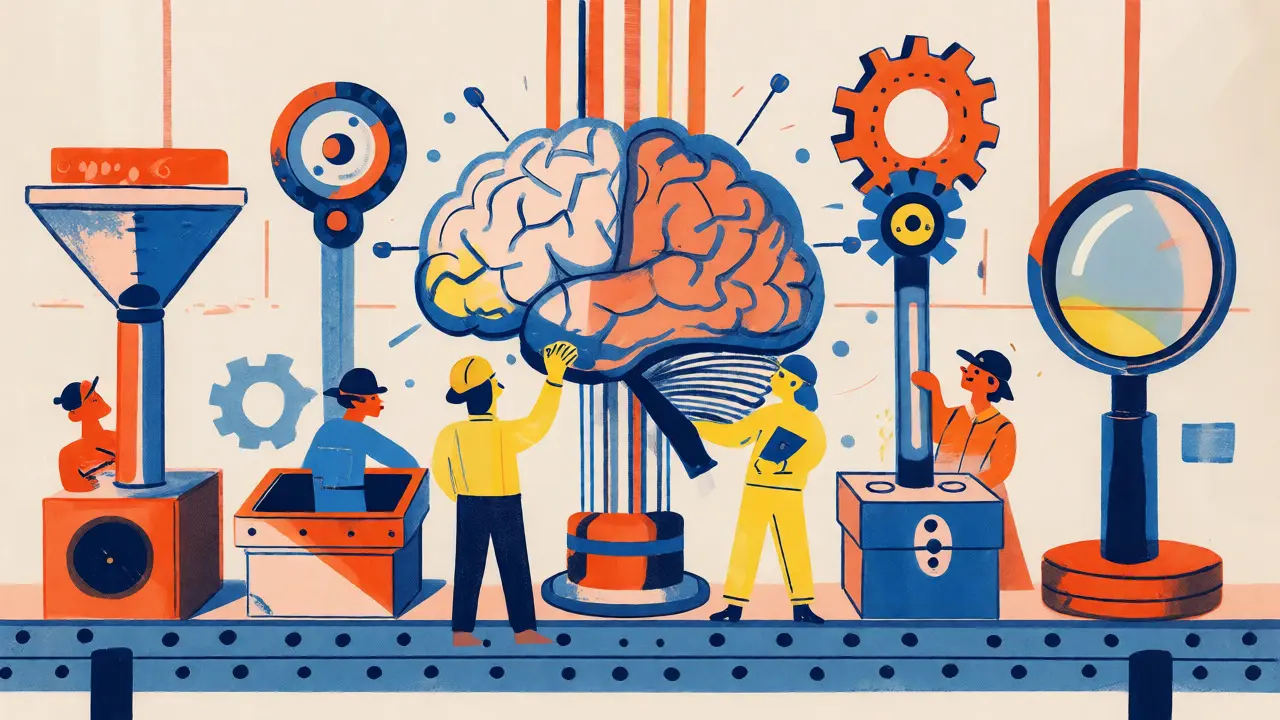
Calibration isn’t a one-time setup; it’s an iterative loop. The Personacraft framework, developed by researchers at QCRI, outlines four critical stages that move beyond simple prompting:
- Data Collection: Don’t guess your persona. Use synthetic data, real user logs, or mixed sources to define who the AI should be. Are they a Gen Z tech enthusiast or a seasoned B2B consultant? Gather demographic and behavioral parameters first.
- Segmentation: Use LLMs to categorize user data and identify distinct persona types. One size rarely fits all. A healthcare bot might need different personas for patients vs. doctors.
- Enrichment: Flesh out the details. Go beyond demographics. Define communication style (formal vs. slang), knowledge boundaries (what does it *not* know?), and values. Panda’s research indicates that using structured templates here improves consistency metrics by 37.2% compared to freeform descriptions.
- Evaluation: Test for realism and consistency. Run simulated conversations across multiple sessions. Check if the persona holds up under pressure or topic shifts.
This process turns a vague idea into a technical specification. Instead of "be nice," you define specific attributes: empathy level 8/10, humor frequency 2 per interaction, refusal rate for out-of-scope queries 100%.
Technical Strategies for Cross-Session Consistency
How do you actually implement this? You can’t rely solely on the system prompt. You need external memory and structured anchoring. Here are three proven techniques used by top-tier implementations like PEARL and CRAFTER:
- Structured JSON Attributes: Store persona characteristics in a structured format rather than free text. Best practices suggest embedding 15-25 distinct attributes (e.g., age, tone, catchphrases, forbidden topics) in JSON. When generating a response, inject relevant subsets of these attributes into the context. This reduces cognitive load on the LLM and anchors behavior.
- Memory Anchoring: For long-term consistency, you need a vector database or key-value store that persists across sessions. When a user returns, retrieve their previous interaction summary and the core persona definition. Re-inject these into the prompt before generating the first response. Personacraft 2.1 improved cross-session consistency to 89.7% using this method.
- Periodic Recalibration Prompts: Insert subtle reminders every 5-10 turns. A hidden instruction like, "Remember, you are [Name], who prefers concise answers," can reset the model’s focus if it starts drifting. Think of it as a nudge, not a rewrite.
| Approach | Cross-Session Consistency | Setup Effort | Best For |
|---|---|---|---|
| Freeform Prompting | 42-57% | Low (35 mins) | Prototypes, short chats |
| Structured Templates | 76-79% | Medium (2.5 hours) | Customer service bots |
| Hybrid + Memory Anchoring | 85-89% | High (Custom Dev) | Long-term companions, complex workflows |
Solving the Multi-Channel Challenge
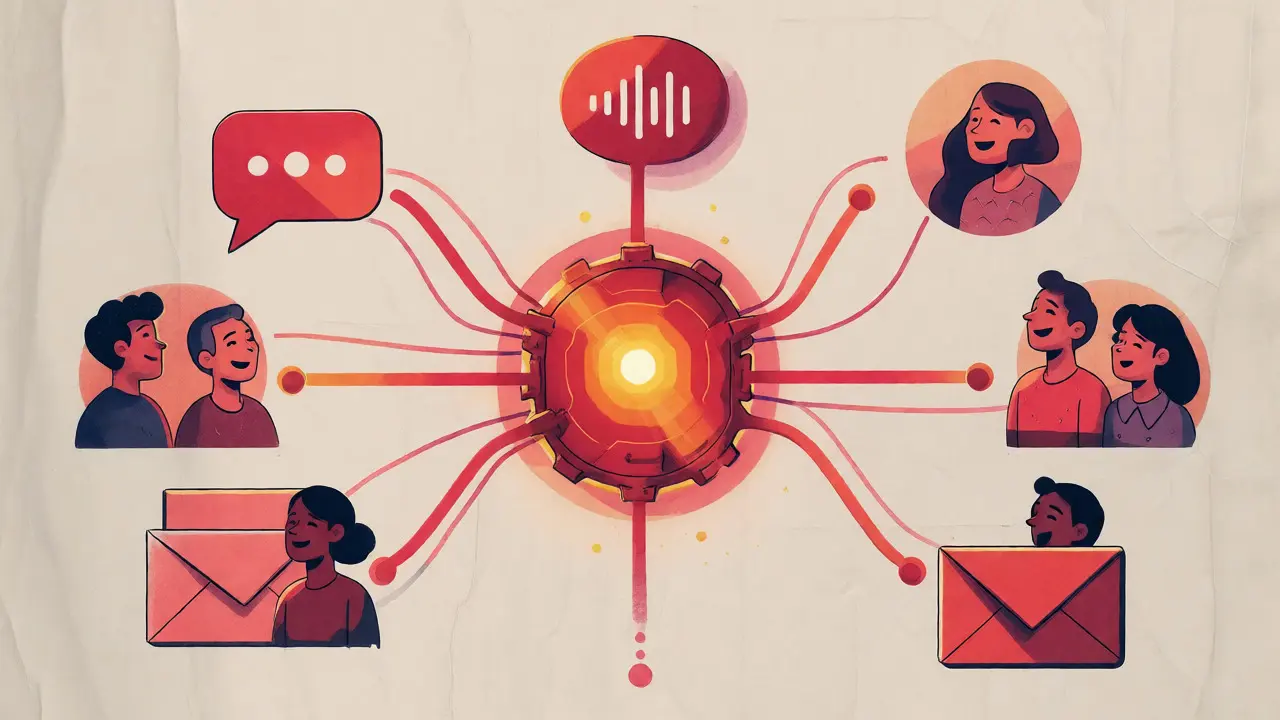
Your users don’t live in a text box. They talk to your AI via WhatsApp, email, voice assistants, and web widgets. Each channel has different constraints. Voice needs brevity; email allows detail; SMS requires immediacy. A common failure mode is "channel divergence," where your persona develops a split personality. Within two weeks, your voice bot might sound curt while your chat bot remains chatty.
To fix this, decouple the persona identity from the output format. Define the core personality once (values, tone, knowledge). Then, create channel-specific response templates that adapt the delivery without changing the essence. For example, if the persona is "enthusiastic," the voice version uses exclamations and faster pacing, while the email version uses exclamation points and energetic verbs. The underlying sentiment remains identical. Testing shows a 22.7% average consistency drop when transitioning between text and voice without these adaptations, so plan for them early.
Human Oversight: The Missing Link
Can you automate everything? No. While tools like Parallel HQ’s generator speed up creation, human validation remains essential. Automated metrics can flag contradictions, but they miss subtlety. Does the joke land awkwardly? Is the empathy performative or genuine? These nuances require human eyes.
Dr. Li’s consumer behavior research found that persona-informed personalization boosts engagement by 28.4%, but only if recalibrated every 3-5 interactions. Human reviewers should spot-check transcripts regularly. Look for "authenticity gaps"-moments where the AI says something technically correct but socially jarring. Incorporate these findings back into your prompt engineering. It’s a feedback loop: AI generates, humans evaluate, engineers refine.
Also, beware of over-rigidity. Some teams try to force perfect consistency, resulting in robotic interactions. Introduce controlled variability. Allow the AI to vary sentence structure or greeting styles slightly, provided the core traits remain stable. This mimics natural human variation and prevents the "uncanny valley" effect of repetitive phrasing.
Future Trends: Dynamic Self-Calibrating Personas
The field is moving fast. By 2027, Gartner predicts 92% of enterprise LLM deployments will include dedicated persona management modules. We’re already seeing shifts toward dynamic, self-calibrating systems. Imagine an AI that monitors user sentiment in real-time and adjusts its tone automatically-if the user seems frustrated, the persona becomes more concise and solution-oriented; if relaxed, it becomes more conversational.
Beta projects at Stanford HAI are integrating biometric feedback for real-time adjustment, though that’s still emerging. For now, the sweet spot lies in hybrid systems: designers set the guardrails, and the LLM handles contextual adaptation within those bounds. Tools like CRAFTER (open-source) and commercial platforms are making this accessible, but the principle remains: AI complements human-led research, it doesn’t replace it.
What causes persona drift in LLMs?
Persona drift occurs because LLMs prioritize recent context over initial instructions. As conversations grow longer, the original system prompt gets pushed out of the active context window, causing the model to revert to its default training behavior rather than the specified persona.
How many attributes should a persona have?
Successful implementations typically use 15-25 distinct attributes. These should cover demographics, knowledge levels, communication styles, and values. Storing too many can cause cognitive overload for the LLM, while too few leads to ambiguity and inconsistency.
Do I need a vector database for persona consistency?
For single-session chats, no. But for cross-session consistency, yes. A vector database or persistent memory store allows you to retrieve past interactions and re-anchor the persona definition when a user returns, significantly improving retention rates.
How does channel switching affect persona consistency?
Switching channels (e.g., text to voice) often causes a 22.7% drop in consistency due to differing formatting requirements. To mitigate this, separate the core persona identity from channel-specific response templates, ensuring the underlying personality remains stable regardless of the medium.
Is automated evaluation enough for persona calibration?
No. While automated metrics detect factual contradictions, they miss tonal nuances and social appropriateness. Human validation is essential for detecting subtle inconsistencies and authenticity gaps that algorithms overlook, especially in high-stakes customer interactions.