Vendor Lock-In in AI-Powered PHP Apps: How to Avoid Trapped Code and Rising Costs
When you build AI features into your PHP app using services like OpenAI, Anthropic, or Google’s Vertex AI, you’re not just adding code—you’re signing up for a long-term relationship. This relationship can turn into vendor lock-in, a situation where switching away from a specific AI provider becomes so costly or complex that you’re stuck, even if prices rise or features lag. Also known as platform dependency, it happens when your app’s core logic, data pipelines, or prompt structures are built tightly around one vendor’s API format, authentication system, or rate limits. Once you’re deep in, rewriting your code to work with another provider isn’t just a tweak—it’s a rebuild.
Many developers fall into this trap because the first version works great. You plug in OpenAI’s API, get fast responses, and ship your chatbot in days. But then your usage grows. Your bill spikes. You need better privacy controls. Or maybe OpenAI changes their pricing model overnight. Now you’re stuck. You can’t easily swap in a local LLM or switch to a cheaper provider because your PHP code assumes specific response formats, token limits, and error codes that only make sense for that one vendor. And if you used their SDKs without abstraction layers, you’re even more trapped. AI APIs, external services that power reasoning, text generation, and data extraction in PHP apps are powerful, but they’re not magic bullets—they’re tools that need guardrails.
Real solutions aren’t about avoiding AI APIs altogether. They’re about designing your PHP code to stay flexible. Use interfaces to wrap API calls so swapping providers means changing one class, not 20 files. Store prompts in external files or databases so you can test different versions without redeploying. Track usage patterns with your own logging so you can spot cost spikes early. And always ask: What happens if this service goes down or gets too expensive? The posts below show how teams handling cloud costs, the ongoing expenses of running AI services in production, often driven by token usage and scaling avoid lock-in by building fallbacks, using hybrid models, and testing alternatives before scaling. You’ll see how PHP scripts, reusable code packages for integrating AI into web applications can be written to support multiple backends, how OpenAI, a leading provider of large language model APIs widely used in PHP applications isn’t the only option, and how to measure your true cost of dependency—not just in dollars, but in time, flexibility, and control.
What follows isn’t theory. These are real examples from developers who got burned by lock-in—and the fixes they built. You’ll find practical code patterns, cost-tracking strategies, and migration roadmaps. No fluff. Just how to keep your PHP app free, fast, and yours.
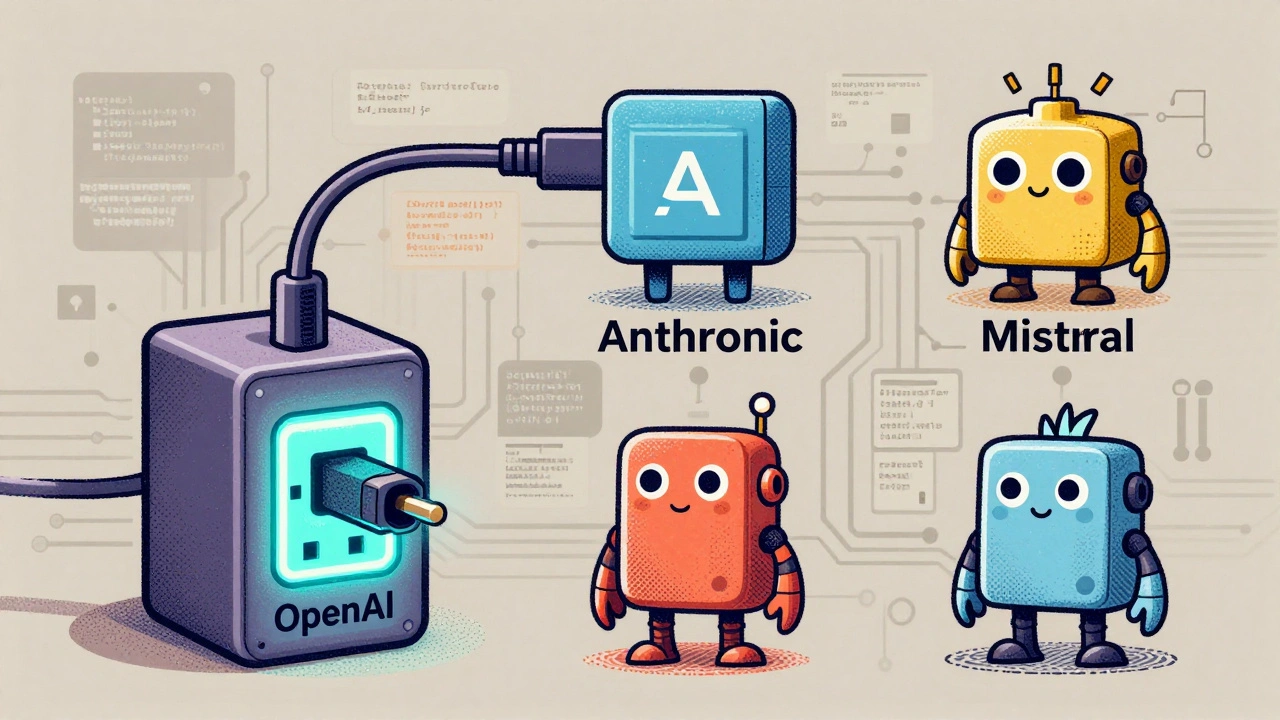
Interoperability Patterns to Abstract Large Language Model Providers
Learn how to abstract large language model providers using proven interoperability patterns like LiteLLM and LangChain to avoid vendor lock-in, reduce costs, and maintain reliability across model changes.
Read More