Model Context Protocol: How AI Systems Understand and Use Context
When you ask an AI a question, it doesn’t just pull an answer from memory—it uses Model Context Protocol, a set of rules and structures that define how an AI model incorporates input, history, and external data to generate a response. Also known as context management, it’s what separates a random guess from a useful, grounded answer. Without it, even the most advanced models like GPT-4 or Claude 3 would hallucinate facts, ignore your instructions, and fail to remember what you just asked.
This protocol isn’t magic. It’s built on three core pieces: prompt engineering, the art of structuring input so the model understands intent and constraints, retrieval-augmented generation (RAG), a technique that pulls in live, relevant data from your own sources to ground responses, and AI inference, the real-time process where the model processes context and generates output. These aren’t optional add-ons—they’re the backbone of any production AI system. Companies that skip proper context handling end up with unreliable chatbots, unsafe content, and ballooning costs from repeated errors.
Think of it like a lawyer preparing for court. They don’t just memorize laws—they gather case files, review client history, and check recent rulings. The Model Context Protocol does the same for AI: it gives the model the right documents, the right tone, the right constraints, and the right sequence of information. That’s why RAG works better than fine-tuning for most business use cases—it’s faster, cheaper, and keeps your data private. And why prompt error analysis matters: if the context is messy, the output will be too.
You’ll find posts here that break down exactly how this works in practice. From how to structure prompts so models don’t ignore key details, to how enterprises use TEEs and vector databases to keep context secure during inference. You’ll see how autoscaling LLM services depends on context length, how multi-tenancy in SaaS apps requires isolated context per user, and why truthfulness benchmarks like TruthfulQA fail when context is poorly managed. These aren’t theoretical ideas—they’re the daily challenges developers face when trying to make AI reliable.
Whether you’re building a customer support bot, a legal assistant, or a sales tool that needs to pull from your CRM, the Model Context Protocol is what makes it work—or break. Below, you’ll find real-world guides, benchmarks, and code patterns that show you how to get it right.
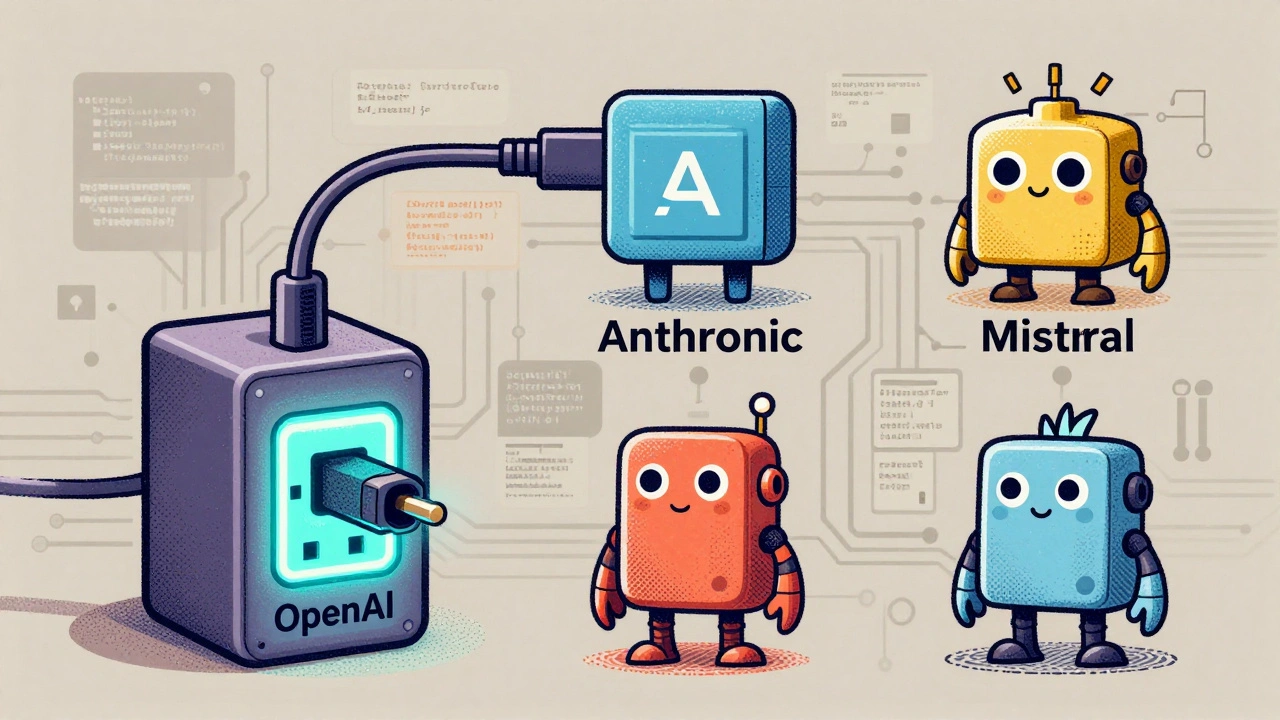
Interoperability Patterns to Abstract Large Language Model Providers
Learn how to abstract large language model providers using proven interoperability patterns like LiteLLM and LangChain to avoid vendor lock-in, reduce costs, and maintain reliability across model changes.
Read More