Blockchain in AI: How Decentralized Tech Powers Secure AI Systems
When you think of blockchain, a distributed ledger that records transactions across many computers so that any involved record cannot be altered retroactively. Also known as distributed ledger technology, it's not just for crypto—it’s becoming a backbone for trustworthy AI systems. Most AI models today run on centralized servers, hidden behind corporate firewalls. But what if you could prove where your model’s training data came from? Or verify that a prediction wasn’t tampered with after it was generated? That’s where blockchain steps in.
smart contracts, self-executing code that runs on blockchain networks when predefined conditions are met are already being used to automate AI governance. For example, a smart contract can lock a model’s weights to a specific hash before deployment, ensuring no one swaps it out later. Meanwhile, decentralized AI, AI systems that distribute computation and data ownership across peer networks instead of relying on single cloud providers is gaining traction in privacy-heavy fields like healthcare and finance. These systems use blockchain to log every data access, model update, and inference request—making audits simple and tampering nearly impossible.
You won’t find blockchain in every AI app yet. But if you’re building anything that needs trust—like a legal document analyzer, a medical diagnosis tool, or a financial risk model—you’re already fighting against data poisoning, model theft, and black-box opacity. Blockchain doesn’t fix bad training data, but it gives you a tamper-proof trail of what was used, who changed what, and when. It’s the digital equivalent of a notarized logbook for your AI.
The posts below show exactly how developers are using blockchain to secure LLMs, verify training datasets, and build open, auditable AI pipelines. No theory. No fluff. Just real code patterns, deployment setups, and security checks that are working today.
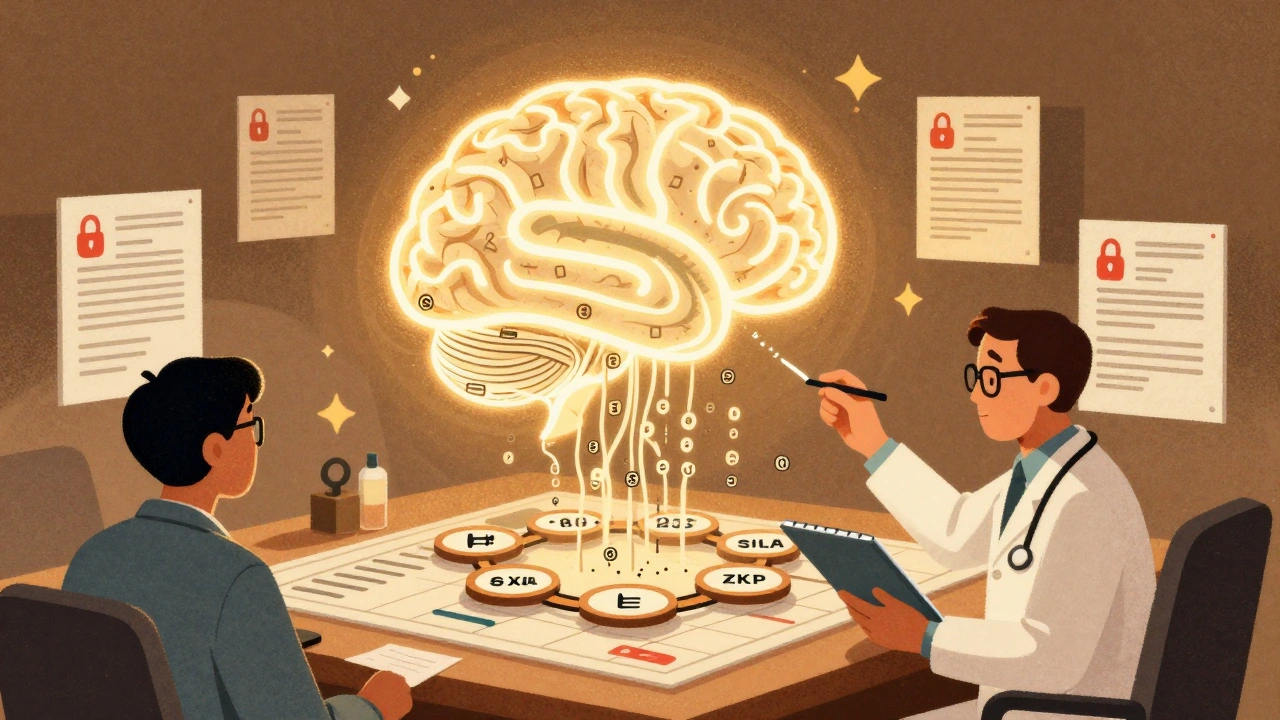
How Generative AI, Blockchain, and Cryptography Are Together Building Trust in Digital Systems
Generative AI, blockchain, and cryptography are merging to create systems that prove AI decisions are trustworthy, private, and unchangeable. This combo is already reducing fraud in healthcare and finance - and it’s just getting started.
Read More