Hybrid Cloud for AI: Combine Public and Private Resources to Power Your PHP Apps
When you run AI in production, you don’t have to choose between hybrid cloud, a mix of public cloud services and private infrastructure that gives you flexibility over cost, control, and performance. Also known as multi-cloud strategy, it lets you keep sensitive data on-premises while tapping into powerful public cloud GPUs for heavy AI workloads. This isn’t just theory—teams using hybrid cloud cut their generative AI bills by 60% or more by running batch jobs on spot instances in the public cloud and keeping user sessions on private servers with strict access controls.
The real advantage? You control where your data lives. LLM deployment, the process of putting large language models into real-world use often needs low-latency responses for chatbots or customer support tools. That’s where private infrastructure shines. But training models or processing bulk data? That’s where cloud cost optimization, strategies like scheduling, autoscaling, and spot instances to reduce cloud spending without losing performance makes the biggest difference. You don’t need to move everything to AWS or Azure. You just need to move the right parts.
Most PHP developers think hybrid cloud is for big enterprises with dedicated DevOps teams. That’s not true. With Composer packages that handle API routing between local and cloud models, and tools like LiteLLM to abstract providers, you can build a hybrid system in days. One team used this setup to run a customer service bot: simple queries stayed on a small private LLM, complex ones got forwarded to a public cloud model. Their monthly cloud bill dropped 70%, and users never noticed the difference.
Security isn’t sacrificed either. Confidential computing and encrypted model weights let you run inference on public clouds without exposing your data. And when you combine this with cloud infrastructure, the underlying systems that power cloud computing, including networks, storage, and virtual machines designed for AI workloads, you get a stack that’s both scalable and secure. You can even use Kubernetes to manage containers across both environments—no need to rebuild your whole pipeline.
Scaling AI isn’t about going all-in on one provider. It’s about knowing where to run what. The posts below show you exactly how real developers are doing this—with PHP. You’ll find guides on cutting cloud costs with spot instances, securing model weights in private data centers, and building systems that switch between public and private models based on demand. No fluff. No vendor hype. Just the code patterns, cost benchmarks, and deployment tricks that work today.
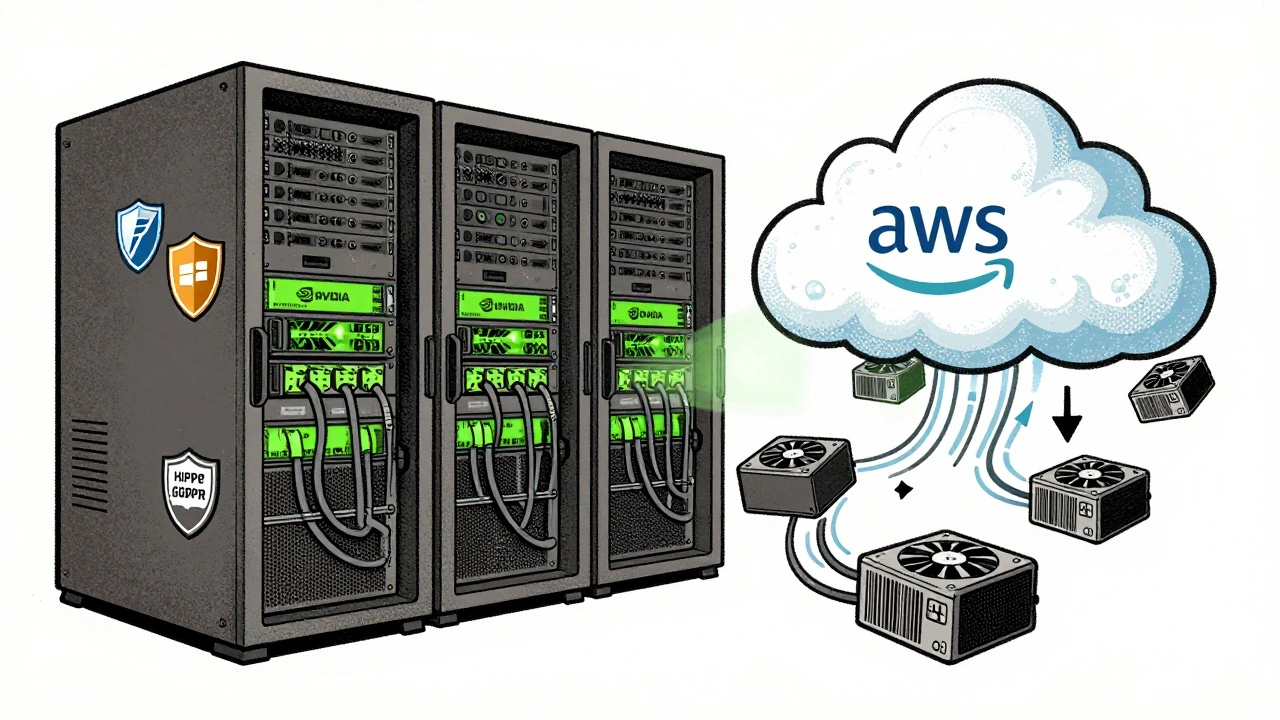
Hybrid Cloud and On-Prem Strategies for Large Language Model Serving
Learn how to balance cost, security, and performance by combining on-prem infrastructure with public cloud for serving large language models. Real-world strategies for enterprises in 2025.
Read More